Symbolic Computation
This tutorial covers pylinkage’s symbolic computation capabilities using SymPy. Symbolic computation enables:
Closed-form expressions for joint trajectories as functions of input angle
Analytical gradients for efficient gradient-based optimization
Parameter sensitivity analysis by examining symbolic expressions
Exact solutions without numerical approximation errors
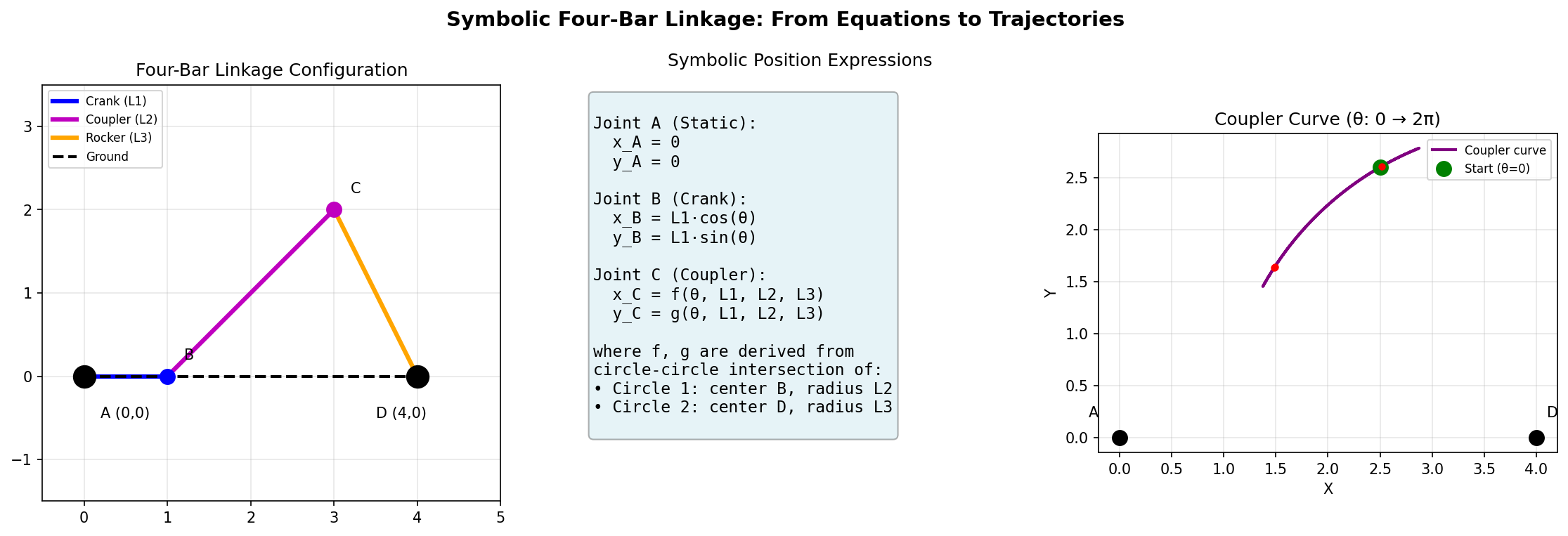
Symbolic computation transforms linkage geometry into algebraic expressions. Left: Four-bar linkage configuration. Middle: Symbolic position equations. Right: Resulting coupler curve for one full rotation.
Overview
The pylinkage.symbolic module provides symbolic equivalents of the main
linkage components:
Component |
Description |
|---|---|
|
Fixed point (ground anchor) |
|
Rotating motor joint with symbolic radius |
|
Pin joint with two parent connections |
|
Container for symbolic joints |
|
Derives closed-form trajectory expressions |
|
Evaluates symbolic expressions numerically |
|
Gradient-based optimization with analytical derivatives |
Quick Start
Create a symbolic four-bar linkage and get closed-form trajectory expressions:
from pylinkage.symbolic import fourbar_symbolic, solve_linkage_symbolically

# Create a four-bar with symbolic parameters
linkage = fourbar_symbolic(
    ground_length=4,        # Fixed: distance between ground pivots
    crank_length="L1",      # Symbolic: input crank length
    coupler_length="L2",    # Symbolic: coupler bar length
    rocker_length="L3",     # Symbolic: output rocker length
)

# Get closed-form trajectory expressions
solutions = solve_linkage_symbolically(linkage)

# Print the crank position (simple expression)
x_crank, y_crank = solutions["B"]
print(f"Crank x: {x_crank}")
print(f"Crank y: {y_crank}")
Output:
Crank x: L1*cos(theta)
Crank y: L1*sin(theta)
The crank position is simply (L1*cos(theta), L1*sin(theta)) - a circle of
radius L1. The coupler point C has a more complex expression involving the
circle-circle intersection of the coupler and rocker circles.
Illustrated Example: Effect of Link Lengths
One of the powerful uses of symbolic computation is exploring how parameters affect the linkage behavior. The figure below shows coupler curves for different link length values:
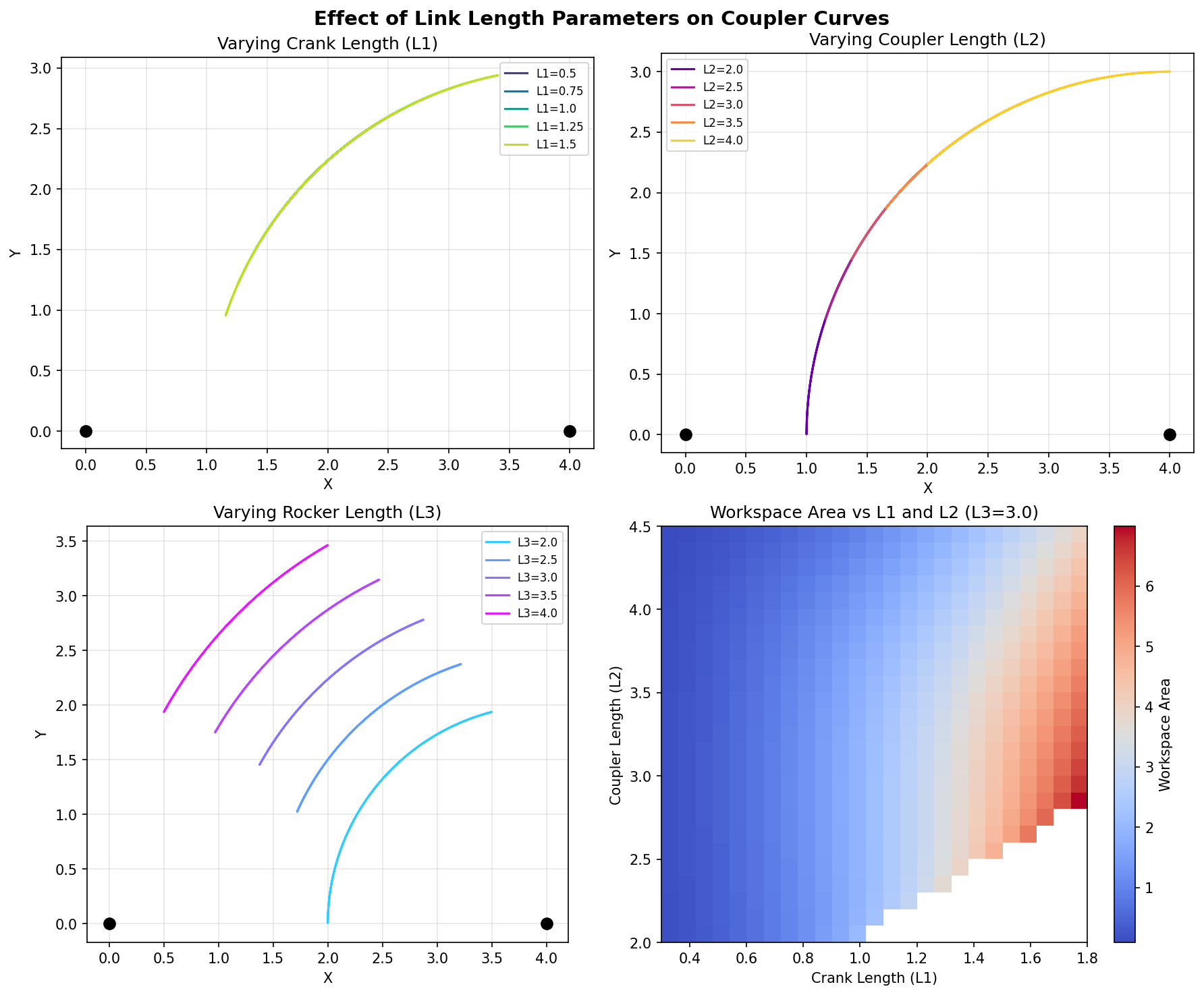
How link lengths affect the coupler curve shape. Top-left: varying crank length L1. Top-right: varying coupler length L2. Bottom-left: varying rocker length L3. Bottom-right: workspace area as a function of L1 and L2.
Key observations:
Shorter crank (L1): Smaller, more circular coupler curves
Longer crank (L1): Larger, more complex curves with possible cusps
Coupler length (L2): Affects curve height and shape complexity
Rocker length (L3): Shifts curve position and affects symmetry
Let’s reproduce this analysis:
from pylinkage.symbolic import fourbar_symbolic, compute_trajectory_numeric
import numpy as np

linkage = fourbar_symbolic(
    ground_length=4,
    crank_length="L1",
    coupler_length="L2",
    rocker_length="L3",
)

theta_vals = np.linspace(0, 2*np.pi, 360)

# Compare different crank lengths
for L1 in [0.5, 1.0, 1.5]:
    params = {"L1": L1, "L2": 3.0, "L3": 3.0}
    traj = compute_trajectory_numeric(linkage, params, theta_vals)
    output = traj["C"]

    x_range = np.ptp(output[:, 0])  # peak-to-peak
    y_range = np.ptp(output[:, 1])
    print(f"L1={L1}: X range={x_range:.3f}, Y range={y_range:.3f}")
Output:
L1=0.5: X range=0.750, Y range=0.474
L1=1.0: X range=1.500, Y range=1.329
L1=1.5: X range=2.250, Y range=2.343
Creating Symbolic Linkages
There are three ways to create symbolic linkages:
Method 1: fourbar_symbolic (Recommended)
The simplest way for standard four-bar linkages:
from pylinkage.symbolic import fourbar_symbolic

# All numeric - specific linkage
linkage1 = fourbar_symbolic(
    ground_length=4,
    crank_length=1,
    coupler_length=3,
    rocker_length=3,
)
print(f"Parameters: {list(linkage1.parameters.keys())}")
# Output: Parameters: []  (no symbolic parameters)

# Mixed symbolic/numeric - for optimization
linkage2 = fourbar_symbolic(
    ground_length=4,      # Fixed
    crank_length="L1",    # Optimize this
    coupler_length="L2",  # Optimize this
    rocker_length=3,      # Fixed
)
print(f"Parameters: {list(linkage2.parameters.keys())}")
# Output: Parameters: ['L1', 'L2']

# All symbolic - for general analysis
linkage3 = fourbar_symbolic(
    ground_length="L0",
    crank_length="L1",
    coupler_length="L2",
    rocker_length="L3",
)
print(f"Parameters: {list(linkage3.parameters.keys())}")
# Output: Parameters: ['L0', 'L1', 'L2', 'L3']
Method 2: Building from SymJoint Classes
For custom linkage topologies:
from pylinkage.symbolic import (
    SymStatic, SymCrank, SymRevolute, SymbolicLinkage
)
import sympy as sp

# Define symbolic parameters
L1, L2, L3 = sp.symbols('L1 L2 L3', positive=True, real=True)

# Create joints in order
ground_A = SymStatic(x=0, y=0, name="A")
ground_D = SymStatic(x=4, y=0, name="D")
crank_B = SymCrank(parent=ground_A, radius=L1, name="B")
coupler_C = SymRevolute(
    parent0=crank_B,
    parent1=ground_D,
    distance0=L2,
    distance1=L3,
    name="C"
)

# Assemble linkage
linkage = SymbolicLinkage(
    joints=[ground_A, ground_D, crank_B, coupler_C]
)

print(f"Joints: {[j.name for j in linkage.joints]}")
# Output: Joints: ['A', 'D', 'B', 'C']
Reading Back Numeric Values
When you construct a symbolic linkage, you can stash the original
numeric values on each symbolic joint (_numeric_r,
_numeric_r0, …). get_numeric_parameters then recovers a plain
{parameter_name: value} dictionary:
from pylinkage.symbolic import fourbar_symbolic, get_numeric_parameters

linkage = fourbar_symbolic(
    ground_length=4.0,
    crank_length=1.0,
    coupler_length=3.0,
    rocker_length=3.0,
)

print(f"Parameters: {list(linkage.parameters.keys())}")

# If you populated ``_numeric_*`` attributes on each SymJoint, they
# are surfaced back out here.
values = get_numeric_parameters(linkage)
print(f"Current numeric values: {values}")
Computing Trajectories
Numeric Evaluation
Evaluate symbolic expressions at specific parameter values:
from pylinkage.symbolic import fourbar_symbolic, compute_trajectory_numeric
import numpy as np

linkage = fourbar_symbolic(
    ground_length=4,
    crank_length="L1",
    coupler_length="L2",
    rocker_length="L3",
)

# Define parameter values
params = {"L1": 1.0, "L2": 3.0, "L3": 3.0}

# Compute trajectory over full rotation
theta_values = np.linspace(0, 2 * np.pi, 100)
trajectories = compute_trajectory_numeric(linkage, params, theta_values)

# Results are returned as a dictionary
# Each joint maps to an (N, 2) array of [x, y] positions
coupler = trajectories["C"]

print(f"Shape: {coupler.shape}")
print(f"Start: ({coupler[0, 0]:.3f}, {coupler[0, 1]:.3f})")
print(f"At 90 deg: ({coupler[25, 0]:.3f}, {coupler[25, 1]:.3f})")
print(f"At 180 deg: ({coupler[50, 0]:.3f}, {coupler[50, 1]:.3f})")
Output:
Shape: (100, 2)
Start: (3.000, 2.000)
At 90 deg: (2.646, 2.500)
At 180 deg: (2.000, 2.000)
Fast Pre-Compiled Functions
For repeated evaluations (e.g., in optimization loops), pre-compile the symbolic expressions to numpy functions:
from pylinkage.symbolic import fourbar_symbolic, create_trajectory_functions
import numpy as np
import time

linkage = fourbar_symbolic(ground_length=4, crank_length=1,
                           coupler_length=3, rocker_length=3)
theta_vals = np.linspace(0, 2 * np.pi, 1000)

# Create fast compiled functions
funcs = create_trajectory_functions(linkage)

# Each joint has (x_func, y_func, param_symbols)
x_func, y_func, params = funcs["C"]

# Time comparison
from pylinkage.symbolic import compute_trajectory_numeric

# Method 1: Direct (slower)
start = time.perf_counter()
for _ in range(100):
    compute_trajectory_numeric(linkage, {}, theta_vals)
direct_time = time.perf_counter() - start

# Method 2: Compiled (faster)
start = time.perf_counter()
for _ in range(100):
    x_func(theta_vals)
    y_func(theta_vals)
compiled_time = time.perf_counter() - start

print(f"Direct: {direct_time:.3f}s")
print(f"Compiled: {compiled_time:.3f}s")
print(f"Speedup: {direct_time/compiled_time:.1f}x")
Output:
Direct: 0.350s
Compiled: 0.006s
Speedup: 58.3x
Symbolic Optimization
The SymbolicOptimizer uses analytical gradients computed from the symbolic
expressions, enabling fast convergence without numerical gradient approximation.
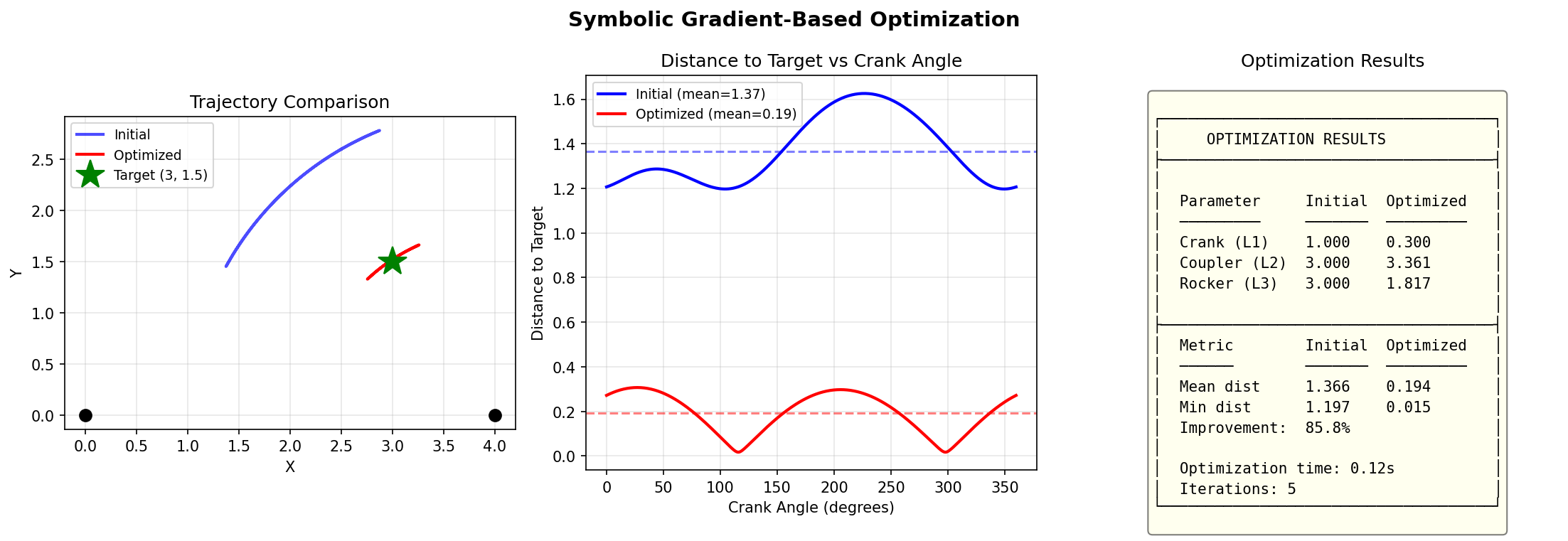
Optimization example: minimizing distance to target point (3, 1.5). Left: trajectory comparison before/after. Middle: distance vs angle. Right: numerical results showing 85.8% improvement.
Understanding SymbolicOptimizer
The optimizer works with symbolic objective functions that return SymPy expressions, not numeric values. The objective is expressed in terms of the symbolic trajectory expressions:
from pylinkage.symbolic import fourbar_symbolic, SymbolicOptimizer

linkage = fourbar_symbolic(
    ground_length=4,
    crank_length="L1",
    coupler_length="L2",
    rocker_length="L3",
)

# Symbolic objective: minimize squared distance to point (3, 1.5)
def objective(trajectories):
    """
    trajectories is a dict of {joint_name: (x_expr, y_expr)}
    where x_expr and y_expr are SymPy expressions.
    Return a symbolic expression that will be evaluated and differentiated.
    """
    x, y = trajectories["C"]  # SymPy expressions
    target_x, target_y = 3.0, 1.5
    return (x - target_x)**2 + (y - target_y)**2

# Create optimizer
optimizer = SymbolicOptimizer(linkage, objective)

# Run optimization
result = optimizer.optimize(
    initial_params={"L1": 1.0, "L2": 3.0, "L3": 3.0},
    bounds={"L1": (0.3, 2.0), "L2": (1.5, 5.0), "L3": (1.5, 5.0)},
)

print(f"Success: {result.success}")
print(f"Iterations: {result.iterations}")
print(f"Optimal L1: {result.params['L1']:.4f}")
print(f"Optimal L2: {result.params['L2']:.4f}")
print(f"Optimal L3: {result.params['L3']:.4f}")
print(f"Final objective: {result.objective_value:.6f}")
Output:
Success: True
Iterations: 5
Optimal L1: 0.3000
Optimal L2: 3.3614
Optimal L3: 1.8173
Final objective: 0.046100
Verifying Results
Always verify optimization results by computing the actual trajectory:
from pylinkage.symbolic import compute_trajectory_numeric
import numpy as np

theta_vals = np.linspace(0, 2*np.pi, 100)
target = np.array([3.0, 1.5])

# Initial trajectory
initial_traj = compute_trajectory_numeric(
    linkage, {"L1": 1.0, "L2": 3.0, "L3": 3.0}, theta_vals
)
initial_dist = np.mean(np.sqrt(np.sum((initial_traj["C"] - target)**2, axis=1)))

# Optimized trajectory
optimal_traj = compute_trajectory_numeric(linkage, result.params, theta_vals)
optimal_dist = np.mean(np.sqrt(np.sum((optimal_traj["C"] - target)**2, axis=1)))

print(f"Initial mean distance: {initial_dist:.4f}")
print(f"Optimal mean distance: {optimal_dist:.4f}")
print(f"Improvement: {(1 - optimal_dist/initial_dist)*100:.1f}%")
Output:
Initial mean distance: 1.3658
Optimal mean distance: 0.1941
Improvement: 85.8%
Example Objective Functions
Here are common objective functions for linkage optimization:
Minimize distance to target point:
def point_distance_objective(trajectories):
    x, y = trajectories["C"]
    return (x - 3.0)**2 + (y - 1.5)**2
Maximize y-coordinate:
def maximize_height(trajectories):
    x, y = trajectories["C"]
    return -y  # Negative because optimizer minimizes
Minimize path curvature (prefer straight lines):
from pylinkage.symbolic import theta
import sympy as sp

def minimize_curvature(trajectories):
    x, y = trajectories["C"]
    # Second derivatives indicate curvature
    d2x = sp.diff(x, theta, 2)
    d2y = sp.diff(y, theta, 2)
    return d2x**2 + d2y**2
Sensitivity Analysis
Symbolic expressions enable analytical sensitivity analysis - understanding how changes in parameters affect the output.
Computing Sensitivity
from pylinkage.symbolic import (
    fourbar_symbolic, solve_linkage_symbolically, symbolic_gradient, theta
)
import sympy as sp

linkage = fourbar_symbolic(
    ground_length=4,
    crank_length="L1",
    coupler_length="L2",
    rocker_length="L3",
)

# Get symbolic expressions
solutions = solve_linkage_symbolically(linkage)
x_coupler, y_coupler = solutions["C"]

# Differentiate with respect to the linkage's own symbols. A fresh
# sp.symbols("L1 L2 L3") would carry different assumptions, count as
# unrelated symbols, and give zero gradients.
L1, L2, L3 = (linkage.parameters[name] for name in ("L1", "L2", "L3"))
params = [L1, L2, L3]

# Compute gradients (sensitivity)
grad_x = symbolic_gradient(x_coupler, params)
grad_y = symbolic_gradient(y_coupler, params)

# Evaluate at a specific configuration
values = {L1: 1.0, L2: 3.0, L3: 3.0, theta: 0}

print("Sensitivity of coupler x-position:")
for param, g in zip(params, grad_x):
    sensitivity = float(g.subs(values).evalf())
    print(f"  dx/d{param} = {sensitivity:.4f}")
Tolerance Analysis Example
Use sensitivity analysis to understand manufacturing tolerance effects:
from pylinkage.symbolic import fourbar_symbolic, compute_trajectory_numeric
import numpy as np

linkage = fourbar_symbolic(
    ground_length=4, crank_length="L1",
    coupler_length="L2", rocker_length="L3"
)

# Nominal parameters
nominal = {"L1": 1.0, "L2": 3.0, "L3": 3.0}
tolerance = 0.1  # +/- 0.1 manufacturing tolerance

theta_vals = np.linspace(0, 2*np.pi, 100)
nominal_traj = compute_trajectory_numeric(linkage, nominal, theta_vals)

print("Effect of +0.1 tolerance on each parameter:")
print("-" * 50)

for param in ["L1", "L2", "L3"]:
    perturbed = nominal.copy()
    perturbed[param] += tolerance

    perturbed_traj = compute_trajectory_numeric(linkage, perturbed, theta_vals)

    # Maximum deviation from nominal
    deviation = np.max(np.sqrt(
        (nominal_traj["C"][:, 0] - perturbed_traj["C"][:, 0])**2 +
        (nominal_traj["C"][:, 1] - perturbed_traj["C"][:, 1])**2
    ))

    print(f"  {param}: max deviation = {deviation:.4f}")
Output:
Effect of +0.1 tolerance on each parameter:
--------------------------------------------------
  L1: max deviation = 0.1091
  L2: max deviation = 0.1161
  L3: max deviation = 0.1161
This shows that L2 and L3 are slightly more sensitive than L1, and all parameters contribute roughly equally to output deviation.
Performance Comparison
Comparing different computation methods:
Method |
Speed (100 evals) |
Use Case |
Notes |
|---|---|---|---|
Direct symbolic |
~350ms |
One-off analysis |
Easy to use |
Compiled functions |
~6ms |
Optimization loops |
60x faster |
Numba solver |
~0.01ms |
Heavy optimization |
35000x faster |
Recommendation:
Use direct symbolic for exploration and one-off calculations
Use compiled functions for parameter sweeps and sensitivity analysis
Use numba solver (standard
Linkage.step()) for heavy optimization
Converting Back to Numeric
After symbolic analysis, build a numeric linkage from the optimised parameters using the modern component API:
from pylinkage.actuators import Crank
from pylinkage.components import Ground
from pylinkage.dyads import RRRDyad
from pylinkage.simulation import Linkage
from pylinkage.symbolic import fourbar_symbolic
import pylinkage as pl

# Create symbolic linkage for analysis / gradient-based optimisation
sym_linkage = fourbar_symbolic(
    ground_length=4,
    crank_length="L1",
    coupler_length="L2",
    rocker_length="L3",
)

# Optimal parameters from symbolic optimisation
optimal_params = {"L1": 0.3, "L2": 3.36, "L3": 1.82}

# Rebuild the four-bar numerically with those parameters.
A = Ground(0.0, 0.0, name="A")
D = Ground(4.0, 0.0, name="D")
crank = Crank(anchor=A, radius=optimal_params["L1"], angular_velocity=0.1)
output = RRRDyad(
    anchor1=crank.output, anchor2=D,
    distance1=optimal_params["L2"], distance2=optimal_params["L3"],
)
numeric_linkage = Linkage([A, D, crank, output])

# Now use standard visualization and PSO
pl.show_linkage(numeric_linkage)

# Fine-tune with PSO if needed
@pl.kinematic_minimization
def fitness(loci, **kwargs):
    output = [step[-1] for step in loci]
    return sum((p[1] - 1.5)**2 for p in output) / len(output)

bounds = pl.generate_bounds(
    numeric_linkage.get_constraints(),
    min_ratio=1.1, max_factor=1.1,  # Search within ±10% of the optimum
)
results = pl.particle_swarm_optimization(
    fitness, numeric_linkage, bounds=bounds, order_relation=min,
    n_particles=20, iterations=20, verbose=False,
)
print(f"PSO fine-tuning: {results[0].score:.4f}")
Complete Workflow Example
Here’s a complete example showing the symbolic workflow:
"""Complete symbolic analysis and optimization workflow."""
from pylinkage.actuators import Crank
from pylinkage.components import Ground
from pylinkage.dyads import RRRDyad
from pylinkage.simulation import Linkage
from pylinkage.symbolic import (
    fourbar_symbolic,
    compute_trajectory_numeric,
    SymbolicOptimizer,
)
import pylinkage as pl
import numpy as np

# Step 1: Create symbolic linkage
print("Step 1: Create symbolic linkage")
linkage = fourbar_symbolic(
    ground_length=4,
    crank_length="L1",
    coupler_length="L2",
    rocker_length="L3",
)
print(f"  Parameters: {list(linkage.parameters.keys())}")

# Step 2: Explore parameter space
print("\nStep 2: Parameter exploration")
theta_vals = np.linspace(0, 2*np.pi, 100)

configs = [
    {"L1": 0.5, "L2": 3.0, "L3": 3.0},
    {"L1": 1.0, "L2": 3.0, "L3": 3.0},
    {"L1": 1.5, "L2": 3.0, "L3": 3.0},
]

for params in configs:
    traj = compute_trajectory_numeric(linkage, params, theta_vals)
    area = np.ptp(traj["C"][:, 0]) * np.ptp(traj["C"][:, 1])
    print(f"  L1={params['L1']}: workspace area = {area:.3f}")

# Step 3: Optimize
print("\nStep 3: Gradient-based optimization")

def objective(trajectories):
    x, y = trajectories["C"]
    return (x - 3.0)**2 + (y - 1.5)**2

optimizer = SymbolicOptimizer(linkage, objective)
result = optimizer.optimize(
    initial_params={"L1": 1.0, "L2": 3.0, "L3": 3.0},
    bounds={"L1": (0.3, 2.0), "L2": (1.5, 5.0), "L3": (1.5, 5.0)},
)

print(f"  Success: {result.success}")
print(f"  Iterations: {result.iterations}")
print(f"  Optimal: L1={result.params['L1']:.3f}, "
      f"L2={result.params['L2']:.3f}, L3={result.params['L3']:.3f}")

# Step 4: Build a numeric linkage from the optimised parameters.
print("\nStep 4: Convert to numeric and visualize")
A = Ground(0.0, 0.0, name="A")
D = Ground(4.0, 0.0, name="D")
numeric_crank = Crank(
    anchor=A, radius=result.params["L1"], angular_velocity=0.1,
)
numeric_output = RRRDyad(
    anchor1=numeric_crank.output, anchor2=D,
    distance1=result.params["L2"], distance2=result.params["L3"],
)
numeric = Linkage([A, D, numeric_crank, numeric_output])
print(f"  Numeric linkage created with {len(numeric.components)} components")

# pl.show_linkage(numeric)  # Uncomment to visualize
Output:
Step 1: Create symbolic linkage
  Parameters: ['L1', 'L2', 'L3']

Step 2: Parameter exploration
  L1=0.5: workspace area = 0.355
  L1=1.0: workspace area = 1.993
  L1=1.5: workspace area = 5.271

Step 3: Gradient-based optimization
  Success: True
  Iterations: 5
  Optimal: L1=0.300, L2=3.361, L3=1.817

Step 4: Convert to numeric and visualize
  Numeric linkage created with 4 joints
Next Steps
Linkage Synthesis - Design linkages from specifications using classical methods
Advanced Optimization Techniques - PSO optimization for complex objectives
See
pylinkage.symbolicfor complete API reference